Understanding Nassau Grouper Protection: How the System Works (and Where It Struggles)
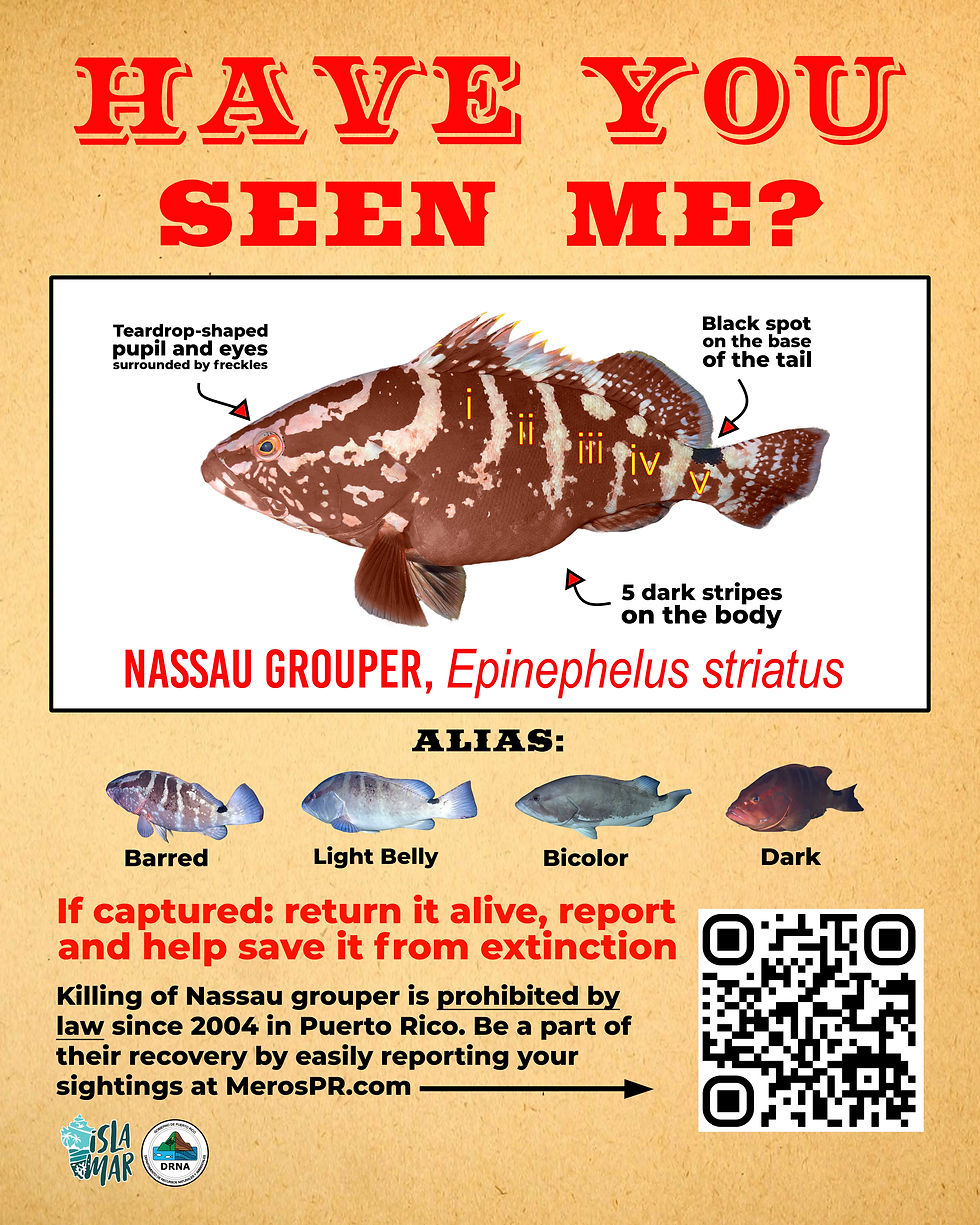
Protecting the Nassau grouper (mero cherna) isn’t handled by just one law or agency—it’s managed through a complex system that spans local Puerto Rico regulations, U.S. federal laws, and even international agreements. While this multi-level framework is designed to protect the species across its entire range, it can also create confusion and enforcement gaps.
Local Laws in Puerto Rico: Strong on Paper, Complicated in Practice
Within 9 nautical miles of Puerto Rico’s coast, two main laws apply—and this is where things start to get complicated.

Under Puerto Rico Wildlife Law (Law 241), Nassau grouper is officially listed as an endangered species. This means that catching, killing, or possessing one can be treated as a serious criminal offense, with penalties including large fines and even jail time. In fact, since a 2014 update, these cases are supposed to be prosecuted as felonies in court.
At the same time, Puerto Rico Fisheries Law (Law 278) also prohibits possession of Nassau grouper—but handles violations very differently. Instead of going to court, cases are often processed through administrative hearings, with much lower fines.
The result? Confusion. Rangers and enforcement officers may not always be sure which law to apply, and some cases fall through the cracks entirely. Even though the stronger law exists, it isn’t always used effectively due to limited training and unclear procedures.
Federal Waters: Clearer Rules, Limited Resources
Beyond 9 nautical miles, in U.S. federal waters, the main law is the Magnuson-Stevens Fishery Conservation and Management Act. This law has banned the harvest and possession of Nassau grouper in federal Caribbean waters since 1990. There’s also the Endangered Species Act, under which Nassau grouper is listed as “threatened”. While that sounds like strong protection, it currently has a major limitation: without a specific rule (called a “4(d) rule”), the ESA cannot actually be used to prosecute someone for catching the fish. That means most enforcement still relies on fisheries law instead.

Another important step came in 2023, when critical habitats were officially designated—areas essential to the species’ survival, including spawning sites such as Bajo de Sico. These protections mainly guide federal actions, but do not directly regulate individual fishers. Enforcement, however, remains a challenge. There is currently only one federal enforcement officer on the island, and no dedicated vessel—meaning local agencies often have to step in to help.
Regional Efforts: Countries Working Together
Because Nassau grouper migrate and spawn across the Caribbean, protecting them requires international cooperation. Organizations like the Western Central Atlantic Fishery Commission (WECAFC) bring together over 30 countries to coordinate conservation efforts. These groups have recommended seasonal fishing closures during spawning months and developed long-term management plans. Similarly, the SPAW Protocol (part of the Cartagena Convention) includes Nassau grouper under a list of species that require protection and recovery efforts across the region. The challenge? These agreements depend on each country to implement and enforce them, and enforcement varies widely across the Caribbean.
Global Perspective: A Species in Trouble

Globally, Nassau grouper is listed as Critically Endangered by conservation groups, reflecting a dramatic population decline over recent decades. While this designation does not create laws, it highlights the urgency of protecting the species.
The Big Challenges
Across all levels—local, federal, and regional—several key issues continue to limit effective protection:
Confusing regulations: Overlapping laws in Puerto Rico make enforcement inconsistent
Limited enforcement capacity: Few officers, limited equipment, and gaps in training
Jurisdictional splits: Different rules apply depending on where the fish is caught
Weak regional enforcement: International agreements are not always binding
Data gaps: Not enough information on catches, bycatch, or spawning sites
Why It Matters
The Nassau grouper plays a critical role in maintaining healthy reef ecosystems and has long been part of Caribbean fishing culture. But without clear, coordinated, and well-enforced protections, recovery will remain difficult. The good news is that the framework already exists. Strengthening communication, improving enforcement, and building trust with fishing communities could make a significant difference. Protecting mero cherna isn’t just about laws—it’s about making those laws work in the real world.


Comments